

Samsung 990 Pro 2TB: the fastest drive on this bench, and two of them in RAID 0
Samsung's Pascal controller and V7 NAND put the 990 Pro ahead of the SK Hynix P41 and the WD_BLACK SN850X in testing here. Then two of them went into RAID 0.
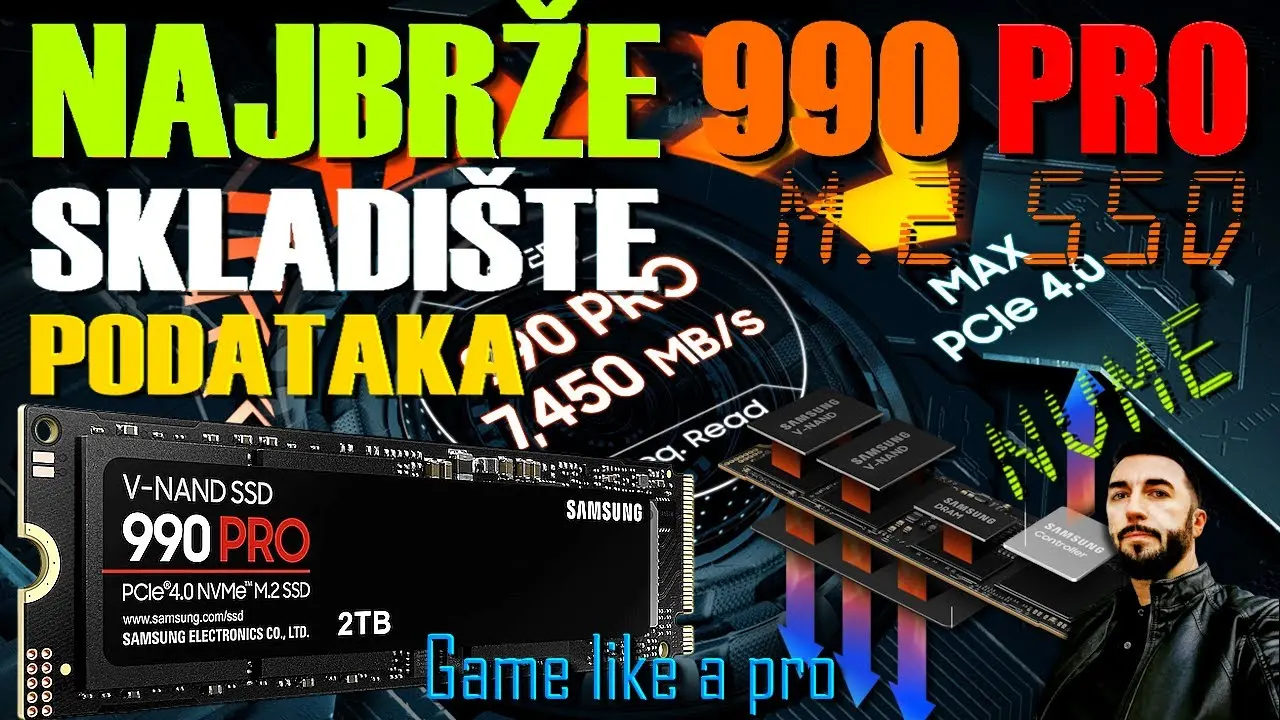
The Samsung 990 Pro 2TB is the fastest storage drive tested on this bench — ahead of both the SK Hynix Platinum P41 and the WD_BLACK SN850X, the two drives it competes with most directly.
What is inside it
The 990 Pro is a generational change rather than a refresh. It pairs Samsung’s new Pascal controller with V7 NAND, and adds a 2GB Low Power DDR4 cache.
| Specification | Detail |
|---|---|
| Form factor | M.2 2280 |
| Interface | PCIe 4.0, NVMe 2.0 |
| Controller | Samsung Pascal |
| NAND | Samsung V-NAND, three-bit MLC |
| Cache | 2GB LPDDR4 |
| Rated sequential read | 7,450 MB/s |
| Capacity tested | 2TB |
The 7,450 MB/s rated figure is for an empty drive, which is worth stating plainly — it is the number every manufacturer quotes and the number no drive sustains once it is full and the SLC cache is exhausted.
PCIe 4.0, not 5.0
The 990 Pro is a PCIe 4.0 drive, and that is the right read of the market at this point. Gen 5 drives exist, run hotter, and need heatsinks that fight with graphics cards for space. A Gen 4 drive at the top of its class is the more sensible buy for a working machine.
Two in RAID 0
Striping two 990 Pros doubles the theoretical sequential throughput and doubles the number of devices that can take your data with them. RAID 0 has no redundancy: one drive failing loses the array.
That trade is defensible for a scratch volume — video project files, render output, model checkpoints you can regenerate. It is not defensible for anything you have not backed up elsewhere. Synthetic benchmarks like CrystalDiskMark 8 will show the array at its best; day-to-day work with many small files will show much less of a difference than the numbers suggest.
Where it lands
Worth it if you want the fastest sensible Gen 4 drive and you value the controller and NAND generation over a spec-sheet Gen 5 number.
RAID 0 is worth it if the data on it is reproducible. If it is not, buy one drive and spend the rest on backup.
Watch this on YouTube
This article accompanies a video on the channel.